
Tax Strategy
By Chris Hilyer, Heritage Wealth Solutions · October 2026 · 6 min read
The short version
- Arizona offers four separate tax credits that many state taxpayers may be eligible to claim, and they stack together for over $5,800 in savings for married couples filing jointly.
- Unlike deductions, these credits come straight off your tax bill, dollar for dollar.
- You don’t need to itemize, there’s no income cap, and you can claim your Arizona credit and still take a federal charitable deduction on the same donation.*
- The STO Switcher credit is one of the least-known opportunities in Arizona tax planning, and it can nearly double your scholarship giving.
“I’ve lived in Arizona for 15 years. How did I not know about these credits?”
After three conversations in two days with clients on the same topic, I knew my blog post for the month had to cover this. Let me be clear: tax filing is not something we do at Heritage Wealth Solutions. But helping you identify opportunities to save money and put the difference back into your own portfolio and your community—absolutely is.
Arizona offers a combination of charitable and education-related tax credits, and a surprising number of residents have either never heard of it or assume they don’t qualify. When you add all the credits together, a married couple filing jointly could reduce their Arizona tax bill by more than $5,800 this year.
Let’s walk through the five things I find most people don’t know.
1. There Are Four Separate Credits, and You Can Claim All of Them
Most people who’ve heard of Arizona tax credits know about one. Maybe two. But Arizona actually offers four distinct credits, and each one has its own cap. That means you’re not choosing between them. You can claim all four in the same tax year.
Here’s the breakdown for 2026:
Qualifying Charitable Organization (QCO) Credit
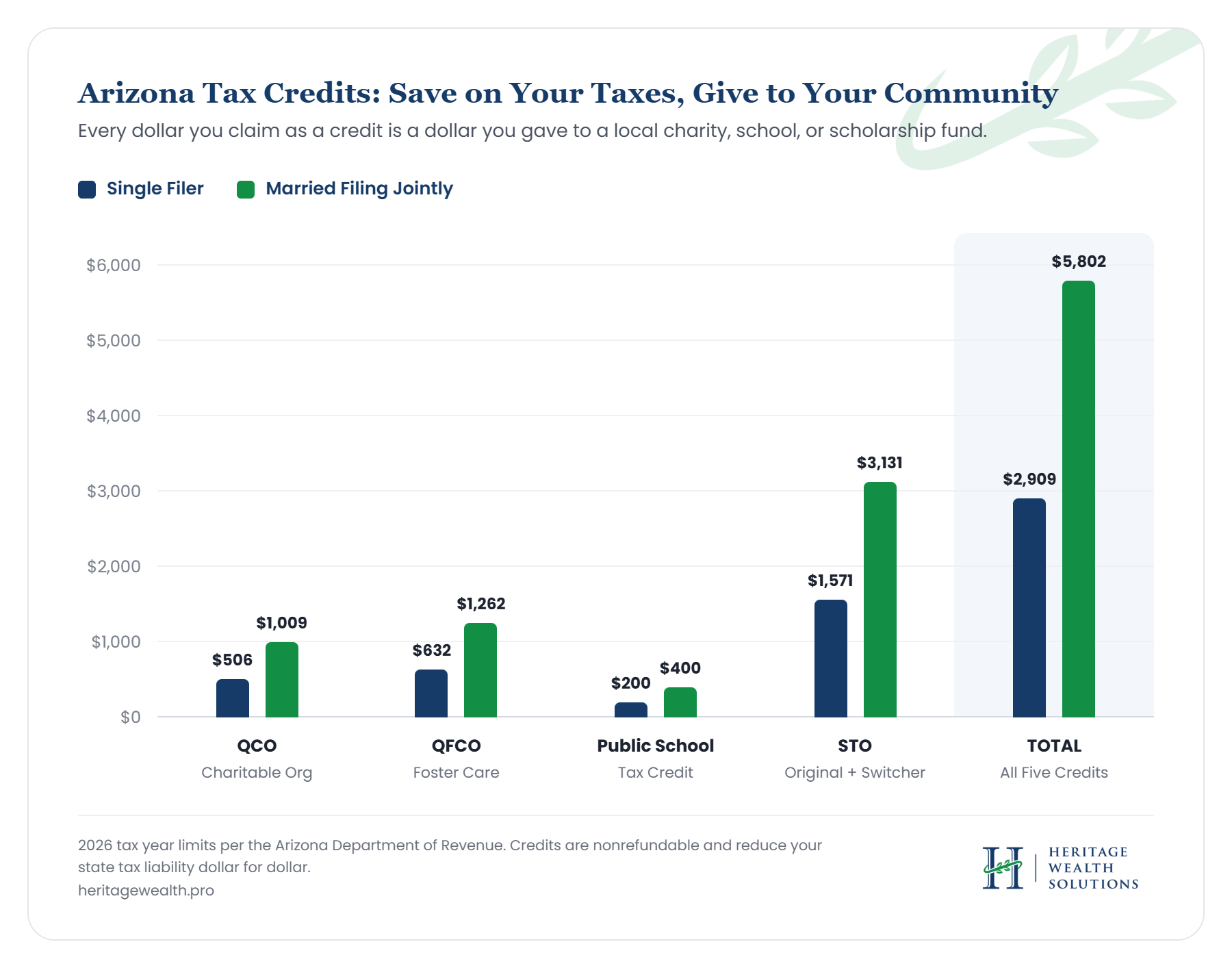
You donate to an approved Arizona charity, and the state gives you a dollar-for-dollar credit on your taxes. Up to $506 for single filers, $1,009 for married filing jointly.
Qualifying Foster Care Charitable Organization (QFCO) Credit
Same idea, but these organizations specifically support foster care in Arizona. Up to $632 single, $1,262 married filing jointly.
Public School Tax Credit
This one goes directly to an Arizona public school for extracurricular activities, character education, and similar programs. Up to $200 single, $400 married filing jointly. And you don’t need to have kids in the school to use it.
School Tuition Organization (STO) Credit
Your donation funds scholarships for students attending private schools in Arizona. Up to $787 single, $1,570 married filing jointly. One thing worth knowing about STO donations: Arizona law allows you to recommend a specific student for a scholarship when you donate. But the STO has final discretion over who receives the award. They can’t issue a scholarship based solely on your recommendation. And there are two important rules. You cannot recommend your own child or any dependent. And “donation swapping” with another parent is strictly illegal under Arizona law. The Arizona Department of Revenue enforces these rules closely.
Single filers: up to $2,125 | Married filing jointly: up to $4,241
And that’s before we get to the one most people have never heard of.
2. The “Switcher” Credit Can Nearly Double Your STO Giving
This is the one that surprises people the most.
Arizona offers a second STO credit called the Switcher credit, and many Arizona taxpayers are eligible to take advantage of it. You don’t need any special eligibility. The only rule is that you max out the Original STO credit first. Once you do, the Switcher credit opens up on top of it. Up to $784 single, $1,561 married filing jointly.
You’re not picking one or the other. You’re stacking them.
So when you combine the Original STO and the Switcher, a married couple can donate up to $3,131 to school tuition organizations and get the full amount back as a tax credit. That’s a significant amount of scholarship funding that may significantly offset Arizona income tax liability for eligible taxpayers.
Married filing jointly: over $5,800 | Single filers: over $2,900
3. These Are Credits, Not Deductions (and the Difference Is Huge)
This is the one that tends to change the conversation. A lot of people hear “tax credit” and think of it the same way they think of a deduction. They’re not the same thing.
A deduction reduces your taxable income. If you’re in the 25% bracket and take a $1,000 deduction, you save $250. A credit comes straight off your tax bill. You owe $3,000 and have $1,000 in credits? You now owe $2,000. Dollar for dollar.
That’s a meaningful distinction, especially when you’re stacking multiple credits together. These Arizona credits are nonrefundable, which means they can reduce your state tax liability to zero but won’t generate a refund on their own. However, if your credits exceed what you owe in a given year, you can carry the unused portion forward for up to five years.
4. You Don’t Need to Itemize, and There’s No Income Cap
Here’s where I see the most confusion. People assume these credits work like federal charitable deductions and that you need to itemize to benefit. That’s not how Arizona’s tax credits work.
You can take the standard deduction and still claim every one of these credits. They’re separate from your deduction choice entirely.
And unlike some tax benefits that phase out at higher income levels, Arizona’s charitable tax credits have no income limit. Whether you’re just starting retirement or you’ve been building wealth for decades, the credits are available to you.
One more thing that surprises people: you can donate to a qualifying organization, claim the Arizona tax credit, and still take a federal charitable deduction for the same donation (assuming you itemize on your federal return). You’re not double-dipping. It’s actually two different tax systems recognizing the same gift.
5. The Deadline Gives You More Flexibility Than You Think
The deadline for Arizona tax credits is April 15th. And here’s the part that catches people off guard: you can make your donation between January 1 and April 15 and choose to apply it to either the current tax year or the prior one.
So if you’re filing your 2025 return right now and you haven’t made any qualifying donations yet, you still have time. You can donate today and apply the credit to your 2025 taxes, as long as it’s before the April 15 filing deadline.
That flexibility also means you don’t have to rush everything into December. You can plan your giving throughout the year and still capture the full credit.
Why This Matters
These credits aren’t just about saving money on your taxes, though that’s certainly part of it. They’re about directing your dollars toward causes that matter to you, whether that’s a local charity, foster care, your neighborhood school, or scholarships for kids who need them.
For people in or near retirement, these credits may be worth discussing with your tax professional as part of your overall tax planning. When you’re managing retirement income, Social Security, required minimum distributions, and state taxes all at once, every tool that reduces what you owe is worth understanding.
And for people who already give to charitable organizations, these credits can make your giving go further. You’re supporting the same causes, and the state is giving you the money back.
Ready to See How These Credits Fit Into Your Plan?
At Heritage Wealth Solutions, we work with clients across Arizona and nationwide to build retirement plans that account for every opportunity, including tax credits most people overlook.
Chris Hilyer, RICP®, CAP®, AIF®, David Ayala, AIF® and their team bring a combined 70 years of experience helping families plan for retirement. We’ll work alongside your CPA or tax professional to make sure you’re capturing every credit available to you.
* Federal tax treatment can vary. Taxpayers should consult their tax professional regarding whether and to what extent a federal charitable deduction may be available.
Frequently Asked Questions About Arizona Tax Credits
Do I need to itemize my taxes to claim Arizona tax credits?
No. Arizona tax credits are separate from your deduction choice. You can take the standard deduction and still claim all four credits (plus the Switcher). They come directly off your state tax bill.
Is there an income limit for Arizona tax credits?
No. Arizona’s charitable tax credits have no income cap. They’re available to all Arizona residents regardless of income level.
Can I claim the Arizona tax credit and a federal deduction for the same donation?
Yes. If you itemize on your federal return, you can take a federal charitable deduction for the same donation that qualifies for an Arizona tax credit. They’re handled by two different tax systems.
What is the STO Switcher credit, and who can use it?
The STO Switcher credit is a second School Tuition Organization credit. Any Arizona taxpayer can use it, but you must first max out the Original STO credit. Once you do, the Switcher credit opens up on top of it. “Switcher” refers to the scholarship side, which targets students transitioning from public to private school or from lower-income families.
What happens if my credits are more than what I owe?
Arizona’s charitable tax credits are nonrefundable, so they can reduce your state tax liability to zero but won’t generate a refund. However, any unused credit can be carried forward for up to five years.
Can I donate after December 31 and still get the credit for the prior year?
Yes. You have until April 15 to make a qualifying donation and apply it to the prior tax year’s return. So if you’re filing your 2025 taxes in early 2026, you can still donate and claim the credit.
Where do I find qualifying organizations?
The Arizona Department of Revenue maintains a list of qualifying charitable organizations (QCOs) and qualifying foster care charitable organizations (QFCOs) at azdor.gov. For STOs, visit the Arizona Department of Revenue’s STO page for a list of certified school tuition organizations.
Changes in tax laws or regulations may occur at any time and could substantially impact your situation. While we are familiar with the tax provisions of the issues presented herein, as Financial Advisors we are not qualified to render advice on tax or legal matters. Raymond James and its advisors do not offer tax or legal advice. You should discuss any tax or legal matters with the appropriate professional.
Any opinions are those of Heritage Wealth Solutions and not necessarily those of Raymond James. Expressions of opinion are as of this date and are subject to change without notice. Raymond James and its advisors do not offer tax or legal advice. You should discuss any tax or legal matters with the appropriate professional. Investing involves risk and you may incur a profit or loss regardless of strategy selected, including diversification and asset allocation. Prior to making an investment decision, please consult with your financial advisor about your individual situation.
Arizona Tax Credits: Credit amounts referenced in this article reflect 2026 tax year limits as published by the Arizona Department of Revenue. Credit amounts are subject to annual adjustment. This information is provided for educational purposes and should not be considered tax advice. Please consult a qualified tax professional regarding your specific situation.
Securities offered through Raymond James Financial Services, Inc., member FINRA/SIPC.