
I’m asked this in almost every meeting where estate planning comes up. And it makes sense.
When Congress passed the One Big Beautiful Bill Act earlier this year, the federal estate tax exemption moved to $15 million per person, or $30 million for a married couple. Permanent. Indexed for inflation. No sunset.
So if your estate falls below $15 million, you likely do not have a federal estate tax problem right now. That part is true.
But estate planning and estate tax planning are two different things. Assuming one takes care of the other is one of the most common planning mistakes I see.
What did the OBBBA change?
The One Big Beautiful Bill Act made the higher federal estate and gift tax exemption permanent. Three things to know:
$15M per individual / $30M per married couple. (Illustrative figures based on current law; consult your estate attorney for amounts applicable to your situation.)
Indexed for inflation. The exemption adjusts each year going forward. There is no scheduled expiration.
40% rate stays. The tax rate on estates above the exemption did not change. Only the threshold moved.
For most American families, this means no federal estate tax exposure at all. That is good news. But it has also created a false sense that estate planning itself is no longer necessary.
Why does estate planning still matter below $15 million?
Because estate planning was never only about the tax bill.
It is about who gets your money when you are gone, who makes decisions if you cannot, and whether your family receives what you intend in the way you intend it. The increase in exemptions did not change any of that.
Beneficiary designations
This is the one I bring up the most because making these simple mistakes can completely derail your intended plan.
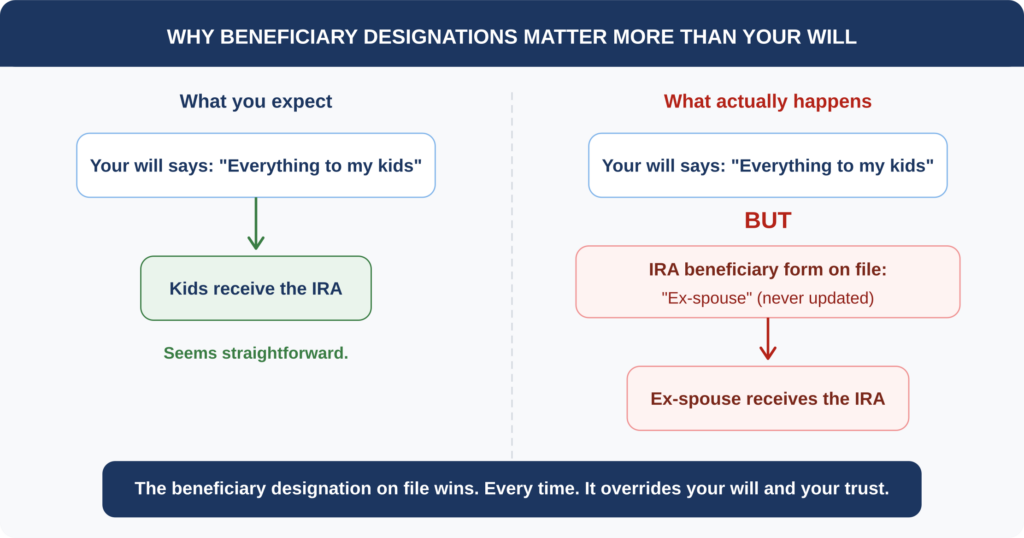
Your designations on IRAs, 401(k)s, and life insurance policies override your will. They override your trust. Assets go directly to whoever is named on the specific form, and courts have upheld this repeatedly.
I have seen clients who updated their will after a divorce but never changed the IRA beneficiary form. The IRA passed to the ex-spouse. The will did not matter. The form on file won.
Here is what that looks like:
Where does your money actually go?
When we talk about beneficiaries in our planning meetings, I tell clients there are really only three places your money can end up:
|
👪
Your Family
Spouses, children, grandchildren. Anyone you want to take care of.
|
❤️
Causes You Care About
Charities, foundations, schools, your church. Organizations doing work that matters to you.
|
💸
The IRS
Whatever is not directed intentionally tends to end up here.
|
The goal of a good estate plan is to make sure more goes to the first two and less goes to the third. That does not happen by accident. It takes intentional decisions about how accounts are titled, who is named on each form, and which assets go where.
The families who get this right are the ones who sit down and ask: who do I actually want to benefit from what I have built? And then they make sure the paperwork matches the answer.
Step-up in basis planning
When you leave appreciated assets to your heirs, those assets generally receive a step-up in cost basis to fair market value at the time of your death. That can eliminate years of built-up capital gains tax.
Which assets you leave, which you give away now, and which you spend during your lifetime all affect the outcome. The exemption level does not change that math.
Powers of attorney and healthcare directives
A durable power of attorney and a healthcare directive have nothing to do with estate taxes. They determine who handles your finances and makes medical decisions if you become incapacitated.
These documents are foundational and a surprising number of people keep putting them off.
Trusts for control and family governance
A trust is much more than a tax tool. Trusts can determine when and how assets reach your children or grandchildren, keep assets out of probate, and create a structure for your family that outlasts you.
Whether your estate is $2 million or $20 million, those goals do not disappear because the federal exemption went up. The question is whether the trust you have, or do not have, still fits where you are today.
The rushed-plan problem
Between 2021 and 2024, many families fast-tracked estate planning strategies to beat a sunset that never came.
The old exemption was scheduled to drop back to roughly $7 million per person at the end of 2025. Families moved quickly to implement strategies: spousal lifetime access trusts (SLATs), grantor-retained annuity trusts (GRATs), and various types of irrevocable trusts.
The OBBBA made the higher exemption permanent, so the sunset never happened.
That does not mean those plans were a mistake. The structure itself may still make sense for your family. But the underlying rationale shifted, and it is worth sitting down with your estate attorney to confirm everything still fits where you are now.
Do state estate taxes still apply?
Yes. This is another often overlooked part of the conversation right now.
The federal exemption and state estate taxes are completely separate. Thirteen states plus the District of Columbia impose their own estate taxes, many with thresholds far below $15 million. Oregon starts at $1 million. Massachusetts starts at $2 million. A family home, retirement accounts, and savings can easily cross those thresholds in higher-cost states.
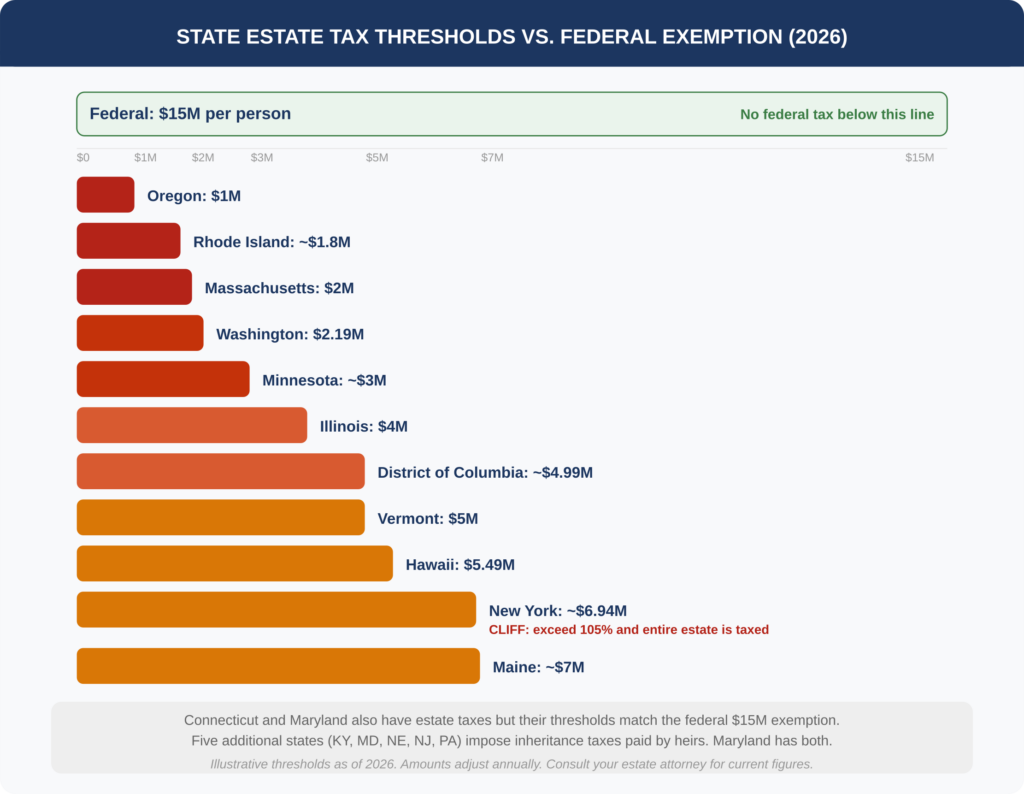
13 states plus DC impose estate taxes with thresholds well below the federal $15M exemption.
New York’s cliff: If your estate exceeds 105% of the state exemption (roughly $7.29 million in 2026), you do not just pay tax on the amount over the threshold. The entire exemption disappears and the whole estate gets taxed from dollar one. The difference in tax between a $6.94 million estate and a $7.3 million estate can exceed $1 million.
Five additional states (Kentucky, Maryland, Nebraska, New Jersey, and Pennsylvania) impose inheritance taxes, which work differently. Those are paid by the heirs based on their relationship to the person who died, not by the estate itself. Maryland is the only state that imposes both.
If you own property in another state, have business interests across state lines, or have recently moved, bring this up in your next planning conversation.
(Illustrative scenario only. Actual tax liability depends on individual circumstances, the structure of the estate, and applicable law at the time of death. Consult your estate attorney and CPA for guidance specific to your situation.)
Ready to review your estate plan?
Estate planning touches almost every corner of a financial plan. It sits alongside your retirement income strategy, your investment accounts, your tax situation, and your family goals.
At Heritage Wealth Solutions, we work through this with clients as part of our planning process. We look at how accounts are titled, who is named as a beneficiary, whether your documents are current, and how your estate fits into the overall picture. We coordinate with your estate attorney and accountant as partners in that process.
We’ve designed our client process to make all this feel manageable.
Or call us at 602-883-4300
Frequently asked questions
Does the $15 million exemption mean I no longer need an estate plan?
No. The exemption applies only to the federal estate tax. Estate planning covers beneficiary designations, powers of attorney, healthcare directives, and trust structures. Most families benefit from having these documents in place regardless of estate size.
What is the current federal estate tax exemption for married couples?
Under current law, the exemption is $15 million per individual and $30 million per married couple, permanently indexed for inflation. (Illustrative figures based on current law; consult your estate attorney for amounts applicable to your situation.)
Does the federal exemption cover state estate taxes?
No. Thirteen states plus DC impose their own estate taxes with thresholds as low as $1 million (Oregon) and $2 million (Massachusetts). New York has a “cliff” where exceeding 105% of the exemption triggers tax on the entire estate. Five additional states impose inheritance taxes paid by heirs.
I set up a SLAT or GRAT in 2024 to beat the sunset. Do I need to undo it?
Not necessarily. The strategy may still serve your family well. But the rationale shifted when the sunset was canceled, and it is worth reviewing the plan with your estate attorney to confirm it still fits.
Raymond James and its advisors do not offer tax or legal advice. You should discuss any tax or legal matters with the appropriate professional.