
The short version
- A Roth conversion moves money from a pre-tax account to a Roth. You pay ordinary income tax now so those dollars can grow and come out untaxed later.
- The 2026 deadline is December 31, with no extension. We recommend finishing by December 15.
- Bracket filling means converting just enough to use up your current bracket without spilling into the next one.
- The strongest cases today are the gap years before Social Security and RMDs, a temporarily low-income year, and protecting heirs from the inherited IRA 10-year rule.
- Watch two tripwires: the OBBBA senior deduction phaseout and the IRMAA cliffs that raise Medicare premiums two years later.
“I keep hearing I should be doing a Roth conversion. Is that true for me?”
I get some version of this question often. So when I sat down to write this blog, I wasn’t surprised to see that searches about “Roth conversions” have spiked across nearly every site this year.
What has changed is the reason people are asking. A few years ago the pitch was urgency: rates might go up in 2026, so convert now. Then Congress made the current brackets permanent and that argument mostly went away.
What replaced it is a better one. The case for converting today rests on three things: where your own income is headed, the required minimum distributions waiting for you at 73 (or 75 for those born in 1960 or later), and what happens to your kids if they inherit a large pre-tax account. Let me start with the basics.
What is a Roth conversion, exactly?
It means moving money from a traditional, pre-tax retirement account into a Roth account. You pay ordinary income tax on the amount you move, in the year you move it.
In exchange, those dollars grow tax-free in the Roth, qualified withdrawals in retirement are not taxed, and no RMDs apply to your own Roth IRA during your lifetime. It is a trade: tax now instead of tax later.
Here is an example of what it might look like for a hypothetical person making $117,000 per year.
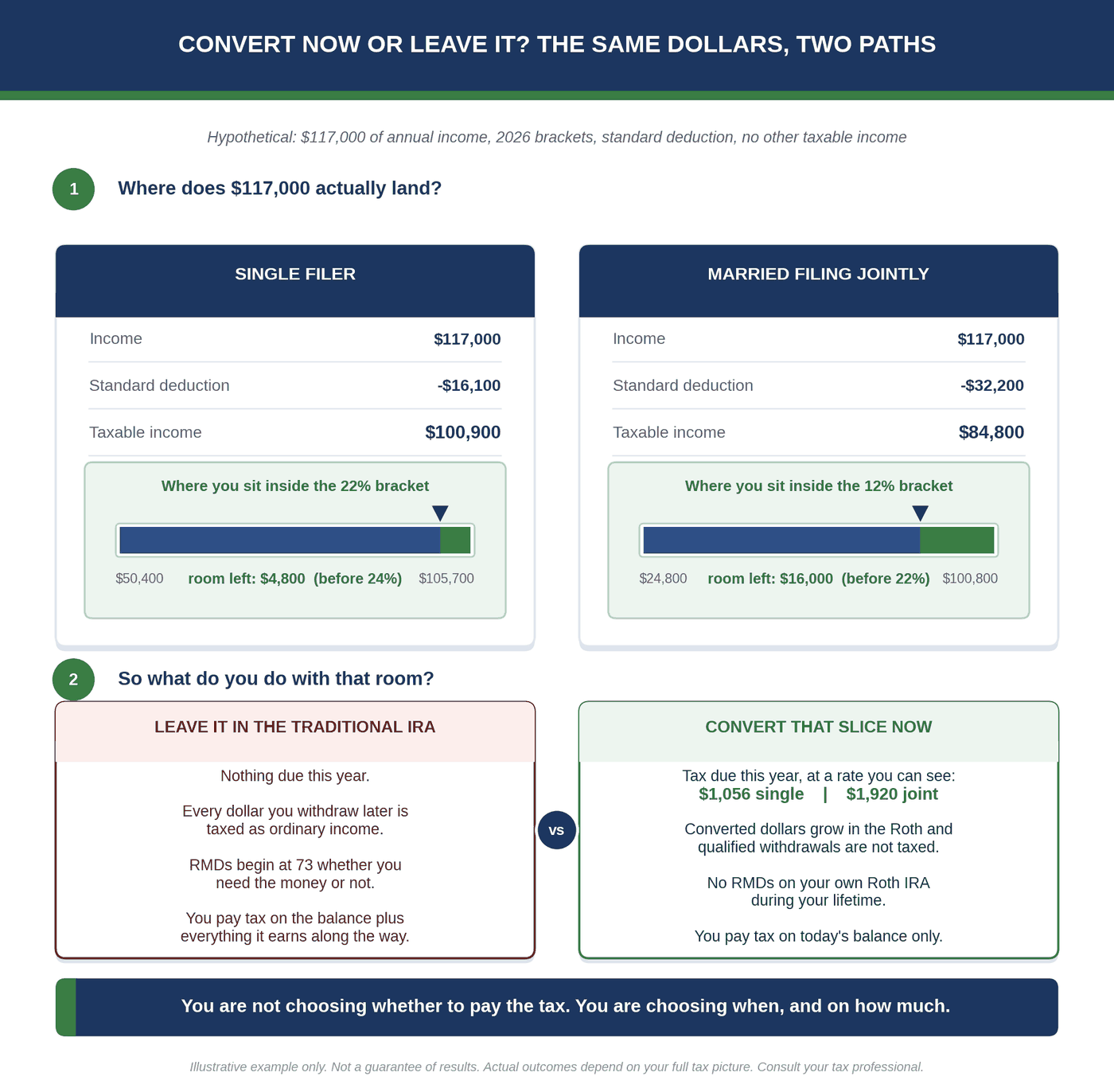
Notice how much the filing status changes the picture. At the same $117,000 of income, a married couple is still sitting in the 12% bracket with real room to work with. A single filer at that income has already crossed into 22% and has very little room before 24%.
That is the whole point of running the numbers before you convert instead of after.
When is the deadline?
Mark the date
December 31, 2026 for the 2026 tax year. There is no extension, and it is not the same as the IRA contribution deadline. We recommend completing conversions by December 15 to leave room for processing and settlement.
People mix this up with IRA contributions, which you can make until the following April. Conversions do not work that way. Once the calendar turns, that year is closed.
Because year-end is when custodians are busiest, I tell clients to have conversions done by December 15. That leaves room for processing and settlement. Waiting until the last week of December is how people miss the window entirely.
Who does a conversion actually work for?
It is not a strategy for everyone, and it is not all-or-nothing. Here is how I think about it.
Worth a closer look if:
- You are in the gap years, the stretch between retiring and when Social Security and RMDs begin. Taxable income often drops here, and this window does not stay open forever.
- You are having a temporarily low-income year: a sabbatical, a business transition, a year with unusually high deductions.
- You have a large pre-tax balance that RMDs will eventually force out at a higher rate than you pay today.
- You live in a state with no income tax, or you expect to.
- You want to leave heirs an account that does not come with a tax bill attached.
Probably not right now if:
- You expect your tax rate to stay flat or drop in retirement.
- Paying the conversion tax would mean pulling from money you cannot easily replace.
- You are close to an IRMAA threshold and the surcharge would outweigh the benefit.
- You will need those specific dollars within five years, before the Roth clock is satisfied. This applies to new accounts, not new money added to an existing account.
How does bracket filling work?
This is the piece most people find useful once they see it drawn out. The idea is to convert just enough to use up the room left in your current bracket, and stop before you spill into the next one.
A note on scope first. The chart below only covers the bottom of the schedule: the standard deduction zone, then the 10%, 12%, and 22% brackets. That is where this couple’s decision actually sits. There are seven brackets in all, and for 2026 a married couple filing jointly looks like this.
Green rows are the brackets this couple fills. The red row is where the chart tells them to stop.
Above 22% the rates keep climbing: 24% starts at $211,401 of taxable income, 32% at $403,551, 35% at $512,451, and 37% at $768,701. None of those come into play here, which is why the chart leaves them off.
Take a hypothetical couple, both 63, who retired two years ago. They have $850,000 in a traditional IRA. They are living on cash savings this year, they have not started Social Security, and RMDs are still a decade off. Their taxable income before any conversion is essentially zero, and that is exactly what creates the room.
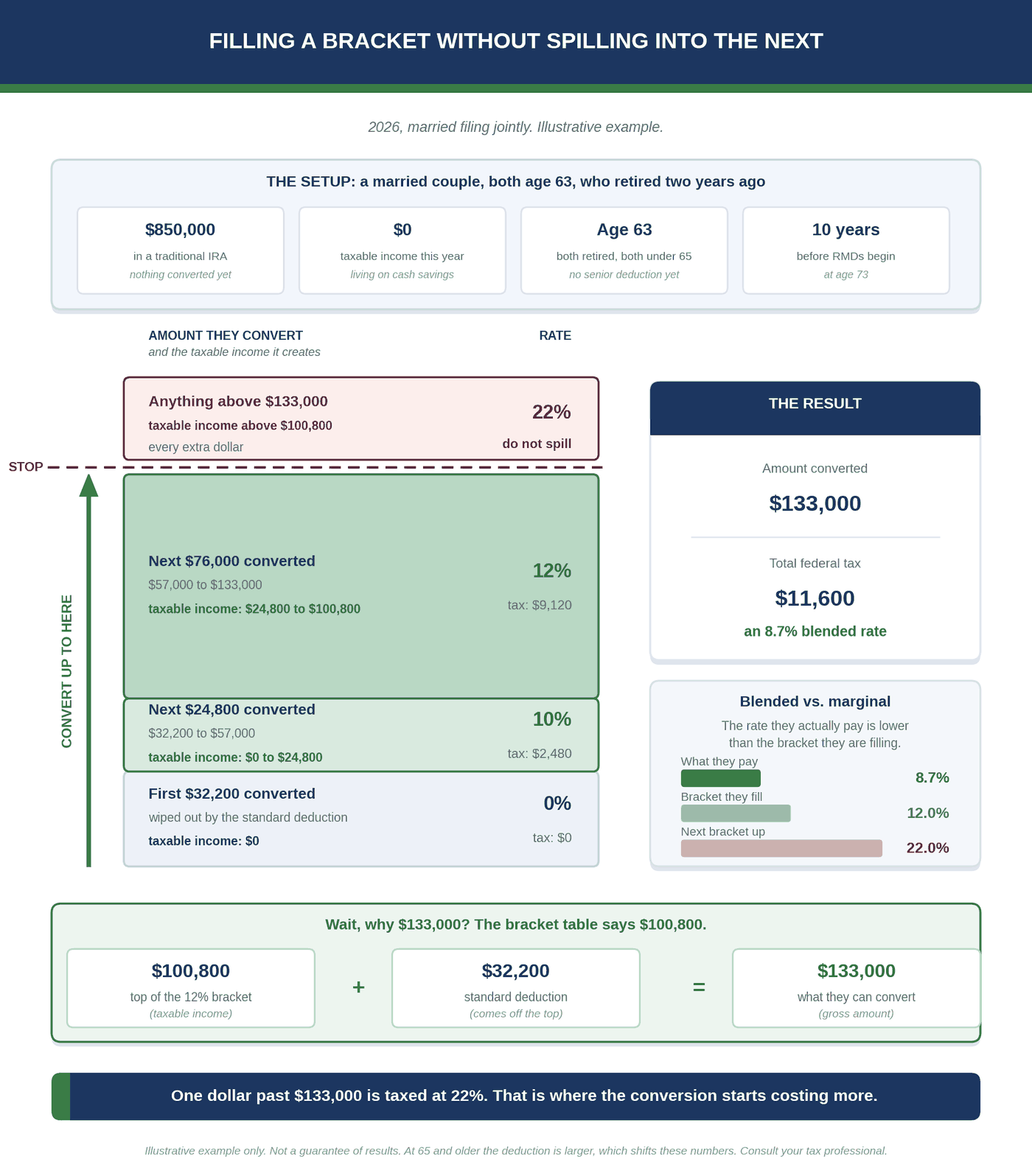
Why $133,000 and not $100,800?
Bracket tables are written in taxable income, which is what is left after your deduction comes off. The 12% bracket for a couple tops out at $100,800. Add back the $32,200 standard deduction and you get $133,000, the amount they could actually move before the next bracket starts.
The number that surprises people is the blended rate. Converting $133,000 sounds like a 12% decision, but because the standard deduction absorbs the first chunk and the next slice is taxed at 10%, the effective cost lands closer to 9%.
Stopping at the top of 12% is a choice, not a rule. Converting past that point is allowed, it just costs more per dollar. Someone with a very large pre-tax balance and a reason to move faster might deliberately fill the 22% bracket, or even the 24%, and accept the higher rate now to shrink a future RMD problem.
One detail in that example matters more than it looks: both spouses are under 65. Once you turn 65 the standard deduction grows, and through 2028 there is an extra senior deduction stacked on top of it. More deduction means more room to convert, so the same couple would be working with a different number a few years from now.
Your own numbers will look different, especially if you have other income. This is a calculation to run against your actual return, not a rule of thumb to borrow.
What about the new senior deduction?
The One Big Beautiful Bill Act added a temporary senior deduction of up to $6,000 per qualifying person age 65 or older, available through 2028, on top of the existing standard and additional senior deductions.
For some households that widens the amount of income landing in the 0% bracket, which can create more conversion room at little or no tax cost. Useful, if it applies to you.
The catch is the phaseout. It begins at $75,000 of income for single filers and $150,000 for couples, and as the deduction shrinks it quietly raises the marginal rate on income falling inside that range. Some advisors have started calling it a hidden surtax, since it is not a bracket you will find on any tax table. It is one more reason to model a conversion rather than estimate it.
Why are heirs driving more of these conversations?
Final IRS regulations issued in 2024 settled how the inherited IRA 10-year rule works. For most non-spouse beneficiaries, including adult children, if the original owner had already started RMDs, the person inheriting has to take annual distributions in years one through nine and empty the account by the end of year ten.
Distributions from Traditional IRAs are taxed as ordinary income to your kids, often landing right in their peak earning years. The IRS waived the penalty for missed distributions from 2021 through 2024 while the rules were being sorted out. That grace period is over.
Converting does not remove the 10-year rule. What it changes is what your heirs actually receive. Dollars converted during your lifetime may pass to them income tax-free, which matters quite a bit if they are decades from retirement and in a higher bracket than you are today.
Could a conversion raise my Medicare premiums?
It can, and this catches people off guard. A conversion adds to your modified adjusted gross income, and MAGI is what determines whether you pay an IRMAA surcharge on Medicare Part B and Part D two years later.
IRMAA is a cliff, not a phase-in
For 2026, the first threshold sits at $109,000 for single filers and $218,000 for joint filers, based on 2024 income. Going one dollar over the line triggers the full surcharge for that tier, for the whole year.
If you are on Medicare or close to it, know exactly where those lines fall before you convert a large amount in a single year.
What mistakes do we see most often?
- Withholding the tax from the conversion itself. It shrinks what actually lands in the Roth. Paying from outside savings keeps more of the conversion working for you. Additionally, the amount witheld from the conversion is seen by the IRS as an “early withdrawal”, and is subject to a 10% penalty at tax time if you are under 59.5 years old.
- Converting too much in one year. It can push you into a higher bracket, trigger the senior deduction phaseout, and cross an IRMAA threshold all at once.
- Opening the Roth too late. The five-year clock for qualified withdrawals does not start until the account exists. Sometimes it is worth opening one with a small conversion just to start it.
- Treating it as once and done. Income, brackets, and deduction rules shift year to year. What made sense last year may not be the right amount this year.
Ready to look at whether a conversion fits?
A conversion touches your tax return, your Medicare premiums, and eventually your heirs’ tax bills. That is more moving parts than a single online calculator handles well.
At Heritage Wealth Solutions, we look at where your income is likely headed, model a few conversion amounts against your specific bracket, and coordinate with your tax professional on the filing side. We do not prepare tax returns, and we work alongside your tax professional rather than in place of them.
If you have been wondering whether this is the year to start, that conversation is worth having well before December.
Frequently asked questions
Is there an income limit on Roth conversions?
No. Unlike Roth IRA contributions, conversions have no income limit and no cap on the amount you can convert. The limit is practical, not legal: how much tax you are willing to pay this year.
Can I still contribute if I convert?
Yes. Contributions and conversions can both happen in the same tax year. Eligibility to contribute is based on earned income. Conversions do not require earned income at all.
Can I undo a conversion if I change my mind?
No. Recharacterizing a conversion was eliminated under the Tax Cuts and Jobs Act. Once it is done, it is done, which is why the amount deserves some thought up front.
When is the deadline for a 2026 Roth conversion?
December 31, 2026. There is no extension, and it is different from the IRA contribution deadline. We recommend completing conversions by December 15 to allow for processing and settlement.
Do I have to convert the whole account at once?
Not at all. Partial conversions spread across several years are far more common, and usually the point is to convert a measured amount each year rather than all of it in one.
Will a conversion affect how my Social Security is taxed?
It can. A conversion raises your income for the year, which may increase the share of your Social Security benefits subject to tax. Worth modeling alongside the IRMAA question.
Any opinions are those of Chris Hilyer and not necessarily those of Raymond James. The information has been obtained from sources considered to be reliable, but we do not guarantee that the foregoing material is accurate or complete. Expressions of opinion are as of this date and are subject to change without notice.
Unless certain criteria are met, Roth IRA owners must be 59½ or older and have held the IRA for five years before tax-free withdrawals are permitted. Additionally, each converted amount may be subject to its own five-year holding period. Converting a traditional IRA into a Roth IRA has tax implications. Investors should consult a tax advisor before deciding to do a conversion.
Investing involves risk and you may incur a profit or loss regardless of strategy selected. Prior to making an investment decision, please consult with your financial advisor about your individual situation.